Wrong is the creator-owned magazine of uncanny and disturbing stories.


Friday, 26 June 2020

Mary Postgate


by Rudyard Kipling

Of Miss Mary Postgate, Lady McCausland wrote that she was 'thoroughly conscientious, tidy, companionable, and ladylike. I am very sorry to part with her, and shall always be interested in her welfare.'
Miss Fowler engaged her on this recommendation, and to her surprise, for she had had experience of companions, found that it was true. Miss Fowler was nearer sixty than fifty at the time, but though she needed care she did not exhaust her attendant's vitality. On the contrary, she gave out, stimulatingly and with reminiscences. Her father had been a minor Court official in the days when the Great Exhibition of 1851 had just set its seal on Civilisation made perfect. Some of Miss Fowler's tales, none the less, were not always for the young. Mary was not young, and though her speech was as colourless as her eyes or her hair, she was never shocked. She listened unflinchingly to every one; said at the end, 'How interesting!' or 'How shocking!' as the case might be, and never again referred to it, for she prided herself on a trained mind, which 'did not dwell on these things.' She was, too, a treasure at domestic accounts, for which the village tradesmen, with their weekly books, loved her not. Otherwise she had no enemies; provoked no jealousy even among the plainest; neither gossip nor slander had ever been traced to her; she supplied the odd place at the Rector's or the Doctor's table at half an hour's notice; she was a sort of public aunt to very many small children of the village street, whose parents, while accepting everything, would have been swift to resent what they called 'patronage'; she served on the Village Nursing Committee as Miss Fowler's nominee when Miss Fowler was crippled by rheumatoid arthritis, and came out of six months' fortnightly meetings equally respected by all the cliques.
And when Fate threw Miss Fowler's nephew, an unlovely orphan of eleven, on Miss Fowler's hands, Mary Postgate stood to her share of the business of education as practised in private and public schools. She checked printed clothes-lists, and unitemised bills of extras; wrote to Head and House masters, matrons, nurses and doctors, and grieved or rejoiced over half-term reports. Young Wyndham Fowler repaid her in his holidays by calling her 'Gatepost,' 'Postey,' or 'Packthread,' by thumping her between her narrow shoulders, or by chasing her bleating, round the garden, her large mouth open, her large nose high in air, at a stiff-necked shamble very like a camel's. Later on he filled the house with clamour, argument, and harangues as to his personal needs, likes and dislikes, and the limitations of 'you women,' reducing Mary to tears of physical fatigue, or, when he chose to be humorous, of helpless laughter. At crises, which multiplied as he grew older, she was his ambassadress and his interpretress to Miss Fowler, who had no large sympathy with the young; a vote in his interest at the councils on his future; his sewing-woman, strictly accountable for mislaid boots and garments; always his butt and his slave.
And when he decided to become a solicitor, and had entered an office in London; when his greeting had changed from 'Hullo, Postey, you old beast,' to Mornin', Packthread,' there came a war which, unlike all wars that Mary could remember, did not stay decently outside England and in the newspapers, but intruded on the lives of people whom she knew. As she said to Miss Fowler, it was 'most vexatious.' It took the Rector's son who was going into business with his elder brother; it took the Colonel's nephew on the eve of fruit-farming in Canada; it took Mrs. Grant's son who, his mother said, was devoted to the ministry; and, very early indeed, it took Wynn Fowler, who announced on a postcard that he had joined the Flying Corps and wanted a cardigan waistcoat.
'He must go, and he must have the waistcoat,' said Miss Fowler. So Mary got the proper-sized needles and wool, while Miss Fowler told the men of her establishment--two gardeners and an odd man, aged sixty--that those who could join the Army had better do so. The gardeners left. Cheape, the odd man, stayed on, and was promoted to the gardener's cottage. The cook, scorning to be limited in luxuries, also left, after a spirited scene with Miss Fowler, and took the housemaid with her. Miss Fowler gazetted Nellie, Cheape's seventeen-year-old daughter, to the vacant post; Mrs. Cheape to the rank of cook, with occasional cleaning bouts; and the reduced establishment moved forward smoothly.
Wynn demanded an increase in his allowance. Miss Fowler, who always looked facts in the face, said, 'He must have it. The chances are he won't live long to draw it, and if three hundred makes him happy--'
Wynn was grateful, and came over, in his tight-buttoned uniform, to say so. His training centre was not thirty miles away, and his talk was so technical that it had to be explained by charts of the various types of machines. He gave Mary such a chart.
'And you'd better study it, Postey,' he said. 'You'll be seeing a lot of 'em soon.' So Mary studied the chart, but when Wynn next arrived to swell and exalt himself before his womenfolk, she failed badly in cross-examination, and he rated her as in the old days.
'You look more or less like a human being,' he said in his new Service voice. 'You must have had a brain at some time in your past. What have you done with it? Where d'you keep it? A sheep would know more than you do, Postey. You're lamentable. You are less use than an empty tin can, you dowey old cassowary.'
'I suppose that's how your superior officer talks to you?' said Miss Fowler from her chair.
'But Postey doesn't mind,' Wynn replied. 'Do you, Packthread?'
'Why? Was Wynn saying anything? I shall get this right next time you come,' she muttered, and knitted her pale brows again over the diagrams of Taubes, Farmans, and Zeppelins.
In a few weeks the mere land and sea battles which she read to Miss Fowler after breakfast passed her like idle breath. Her heart and her interest were high in the air with Wynn, who had finished 'rolling' (whatever that might be) and had gone on from a 'taxi' to a machine more or less his own. One morning it circled over their very chimneys, alighted on Vegg's Heath, almost outside the garden gate, and Wynn came in, blue with cold, shouting for food. He and she drew Miss Fowler's bath-chair, as they had often done, along the Heath foot-path to look at the bi-plane. Mary observed that 'it smelt very badly.'
'Postey, I believe you think with your nose,' said Wynn. 'I know you don't with your mind. Now, what type's that?'
'I'll go and get the chart,' said Mary.
'You're hopeless! You haven't the mental capacity of a white mouse,' he cried, and explained the dials and the sockets for bomb-dropping till it was time to mount and ride the wet clouds once more.
'Ah!' said Mary, as the stinking thing flared upward. 'Wait till our Flying Corps gets to work! Wynn says it's much safer than in the trenches.'
'I wonder,' said Miss Fowler. 'Tell Cheape to come and tow me home again.'
'It's all downhill. I can do it,' said Mary, 'if you put the brake on.' She laid her lean self against the pushing-bar and home they trundled.
'Now, be careful you aren't heated and catch a chill,' said overdressed Miss Fowler.
'Nothing makes me perspire,' said Mary. As she bumped the chair under the porch she straightened her long back. The exertion had given her a colour, and the wind had loosened a wisp of hair across her forehead. Miss Fowler glanced at her.
'What do you ever think of, Mary?' she demanded suddenly.
'Oh, Wynn says he wants another three pairs of stockings--as thick as we can make them.'
'Yes. But I mean the things that women think about. Here you are, more than forty--'
'Forty-four,' said truthful Mary.
'Well?'
'Well?' Mary offered Miss Fowler her shoulder as usual.
'And you've been with me ten years now.'
'Let's see,' said Mary. 'Wynn was eleven when he came. He's twenty now, and I came two years before that. It must be eleven.'
'Eleven! And you've never told me anything that matters in all that while. Looking back, it seems to me that I've done all the talking.'
'I'm afraid I'm not much of a conversationalist. As Wynn says, I haven't the mind. Let me take your hat.'
Miss Fowler, moving stiffly from the hip, stamped her rubber-tipped stick on the tiled hall floor. 'Mary, aren't you anything except a companion? Would you ever have been anything except a companion?'
Mary hung up the garden hat on its proper peg. 'No,' she said after consideration. 'I don't imagine I ever should. But I've no imagination, I'm afraid.'
She fetched Miss Fowler her eleven-o'clock glass of Contrexéville.
That was the wet December when it rained six inches to the month, and the women went abroad as little as might be. Wynn's flying chariot visited them several times, and for two mornings (he had warned her by postcard) Mary heard the thresh of his propellers at dawn. The second time she ran to the window, and stared at the whitening sky. A little blur passed overhead. She lifted her lean arms towards it.
That evening at six o'clock there came an announcement in an official envelope that Second Lieutenant W. Fowler had been killed during a trial flight. Death was instantaneous. She read it and carried it to Miss Fowler.
'I never expected anything else,' said Miss Fowler; 'but I'm sorry it happened before he had done anything.'
The room was whirling round Mary Postgate, but she found herself quite steady in the midst of it.
'Yes,' she said. 'It's a great pity he didn't die in action after he had killed somebody.'
'He was killed instantly. That's one comfort,' Miss Fowler went on.
'But Wynn says the shock of a fall kills a man at once--whatever happens to the tanks,' quoted Mary.
The room was coming to rest now. She heard Miss Fowler say impatiently, 'But why can't we cry, Mary?' and herself replying, 'There's nothing to cry for. He has done his duty as much as Mrs. Grant's son did.'
'And when he died, she came and cried all the morning,' said Miss Fowler. 'This only makes me feel tired--terribly tired. Will you help me to bed, please, Mary?--And I think I'd like the hot-water bottle.'
So Mary helped her and sat beside, talking of Wynn in his riotous youth.
'I believe,' said Miss Fowler suddenly, 'that old people and young people slip from under a stroke like this. The middle-aged feel it most.'
'I expect that's true,' said Mary, rising. 'I'm going to put away the things in his room now. Shall we wear mourning?'
'Certainly not,' said Miss Fowler. 'Except, of course, at the funeral. I can't go. You will. I want you to arrange about his being buried here. What a blessing it didn't happen at Salisbury!'
Every one, from the Authorities of the Flying Corps to the Rector, was most kind and sympathetic. Mary found herself for the moment in a world where bodies were in the habit of being despatched by all sorts of conveyances to all sorts of places. And at the funeral two young men in buttoned-up uniforms stood beside the grave and spoke to her afterwards.
'You're Miss Postgate, aren't you?' said one. 'Fowler told me about you. He was a good chap--a first-class fellow--a great loss.'
'Great loss!' growled his companion. 'We're all awfully sorry.'
'How high did he fall from?' Mary whispered.
'Pretty nearly four thousand feet, I should think, didn't he? You were up that day, Monkey?'
'All of that,' the other child replied. 'My bar made three thousand, and I wasn't as high as him by a lot.'
'Then that's all right,' said Mary. 'Thank you very much.'
They moved away as Mrs. Grant flung herself weeping on Mary's flat chest, under the lych-gate, and cried, 'I know how it feels! I know how it feels!'
'But both his parents are dead,' Mary returned, as she fended her off. 'Perhaps they've all met by now,' she added vaguely as she escaped towards the coach.
'I've thought of that too,' wailed Mrs. Grant; 'but then he'll be practically a stranger to them. Quite embarrassing!'
Mary faithfully reported every detail of the ceremony to Miss Fowler, who, when she described Mrs. Grant's outburst, laughed aloud.
'Oh, how Wynn would have enjoyed it! He was always utterly unreliable at funerals. D'you remember--' And they talked of him again, each piecing out the other's gaps. 'And now,' said Miss Fowler, 'we'll pull up the blinds and we'll have a general tidy. That always does us good. Have you seen to Wynn's things?'
'Everything--since he first came,' said Mary. 'He was never destructive--even with his toys.'
They faced that neat room.
'It can't be natural not to cry,' Mary said at last. 'I'm so afraid you'll have a reaction.'
'As I told you, we old people slip from under the stroke. It's you I'm afraid for. Have you cried yet?'
'I can't. It only makes me angry with the Germans.'
'That's sheer waste of vitality,' said Miss Fowler. 'We must live till the war's finished.' She opened a full wardrobe. 'Now, I've been thinking things over. This is my plan. All his civilian clothes can be given away--Belgian refugees, and so on.'
Mary nodded. 'Boots, collars, and gloves?'
'Yes. We don't need to keep anything except his cap and belt.'
'They came back yesterday with his Flying Corps clothes'--Mary pointed to a roll on the little iron bed.
'Ah, but keep his Service things. Some one may be glad of them later. Do you remember his sizes?'
'Five feet eight and a half; thirty-six inches round the chest. But he told me he's just put on an inch and a half. I'll mark it on a label and tie it on his sleeping-bag.'
'So that disposes of that,' said Miss Fowler, tapping the palm of one hand with the ringed third finger of the other. 'What waste it all is! We'll get his old school trunk to-morrow and pack his civilian clothes.'
'And the rest?' said Mary. 'His books and pictures and the games and the toys--and--and the rest?'
'My plan is to burn every single thing,' said Miss Fowler. 'Then we shall know where they are and no one can handle them afterwards. What do you think?'
'I think that would be much the best,' said Mary. 'But there's such a lot of them.'
'We'll burn them in the destructor,' said Miss Fowler.
This was an open-air furnace for the consumption of refuse; a little circular four-foot tower of pierced brick over an iron grating. Miss Fowler had noticed the design in a gardening journal years ago, and had had it built at the bottom of the garden. It suited her tidy soul, for it saved unsightly rubbish-heaps, and the ashes lightened the stiff clay soil.
Mary considered for a moment, saw her way clear, and nodded again. They spent the evening putting away well-remembered civilian suits, underclothes that Mary had marked, and the regiments of very gaudy socks and ties. A second trunk was needed, and, after that, a little packing-case, and it was late next day when Cheape and the local carrier lifted them to the cart. The Rector luckily knew of a friend's son, about five feet eight and a half inches high, to whom a complete Flying Corps outfit would be most acceptable, and sent his gardener's son down with a barrow to take delivery of it. The cap was hung up in Miss Fowler's bedroom, the belt in Miss Postgate's; for, as Miss Fowler said, they had no desire to make tea-party talk of them.
'That disposes of that,' said Miss Fowler. 'I'll leave the rest to you, Mary. I can't run up and down the garden. You'd better take the big clothes-basket and get Nellie to help you.'
'I shall take the wheel-barrow and do it myself,' said Mary, and for once in her life closed her mouth.
Miss Fowler, in moments of irritation, had called Mary deadly methodical. She put on her oldest waterproof and gardening-hat and her ever-slipping goloshes, for the weather was on the edge of more rain. She gathered fire-lighters from the kitchen, a half-scuttle of coals, and a faggot of brushwood. These she wheeled in the barrow down the mossed paths to the dank little laurel shrubbery where the destructor stood under the drip of three oaks. She climbed the wire fence into the Rector's glebe just behind, and from his tenant's rick pulled two large armfuls of good hay, which she spread neatly on the fire-bars. Next, journey by journey, passing Miss Fowler's white face at the morning-room window each time, she brought down in the towel-covered clothes-basket, on the wheel-barrow, thumbed and used Hentys, Marryats, Levers, Stevensons, Baroness Orczys, Garvices, schoolbooks, and atlases, unrelated piles of the Motor Cyclist, the Light Car, and catalogues of Olympia Exhibitions; the remnants of a fleet of sailing-ships from ninepenny cutters to a three-guinea yacht; a prep.-school dressing-gown; bats from three-and-sixpence to twenty-four shillings; cricket and tennis balls; disintegrated steam and clockwork locomotives with their twisted rails; a grey and red tin model of a submarine; a dumb gramophone and cracked records; golf-clubs that had to be broken across the knee, like his walking-sticks, and an assegai; photographs of private and public school cricket and football elevens, and his O.T.C. on the line of march; kodaks, and film-rolls; some pewters, and one real silver cup, for boxing competitions and Junior Hurdles; sheaves of school photographs; Miss Fowler's photograph; her own which he had borne off in fun and (good care she took not to ask!) had never returned; a playbox with a secret drawer; a load of flannels, belts, and jerseys, and a pair of spiked shoes unearthed in the attic; a packet of all the letters that Miss Fowler and she had ever written to him, kept for some absurd reason through all these years; a five-day attempt at a diary; framed pictures of racing motors in full Brooklands career, and load upon load of undistinguishable wreckage of tool-boxes, rabbit-hutches, electric batteries, tin soldiers, fret-saw outfits, and jig-saw puzzles.
Miss Fowler at the window watched her come and go, and said to herself, 'Mary's an old woman. I never realised it before.'
After lunch she recommended her to rest.
'I'm not in the least tired,' said Mary. 'I've got it all arranged. I'm going to the village at two o'clock for some paraffin. Nellie hasn't enough, and the walk will do me good.'
She made one last quest round the house before she started, and found that she had overlooked nothing. It began to mist as soon as she had skirted Vegg's Heath, where Wynn used to descend--it seemed to her that she could almost hear the beat of his propellers overhead, but there was nothing to see. She hoisted her umbrella and lunged into the blind wet till she had reached the shelter of the empty village. As she came out of Mr. Kidd's shop with a bottle full of paraffin in her string shopping-bag, she met Nurse Eden, the village nurse, and fell into talk with her, as usual, about the village children. They were just parting opposite the 'Royal Oak,' when a gun, they fancied, was fired immediately behind the house. It was followed by a child's shriek dying into a wail.
'Accident!' said Nurse Eden promptly, and dashed through the empty bar, followed by Mary. They found Mrs. Gerritt, the publican's wife, who could only gasp and point to the yard, where a little cart-lodge was sliding sideways amid a clatter of tiles. Nurse Eden snatched up a sheet drying before the fire, ran out, lifted something from the ground, and flung the sheet round it. The sheet turned scarlet and half her uniform too, as she bore the load into the kitchen. It was little Edna Gerritt, aged nine, whom Mary had known since her perambulator days.
'Am I hurted bad?' Edna asked, and died between Nurse Eden's dripping hands. The sheet fell aside and for an instant, before she could shut her eyes, Mary saw the ripped and shredded body.
'It's a wonder she spoke at all,' said Nurse Eden. 'What in God's name was it?'
'A bomb,' said Mary.
'One o' the Zeppelins?'
'No. An aeroplane. I thought I heard it on the Heath, but I fancied it was one of ours. It must have shut off its engines as it came down. That's why we didn't notice it.'
'The filthy pigs!' said Nurse Eden, all white and shaken. 'See the pickle I'm in! Go and tell Dr. Hennis, Miss Postgate.' Nurse looked at the mother, who had dropped face down on the floor. 'She's only in a fit. Turn her over.'
Mary heaved Mrs. Gerritt right side up, and hurried off for the doctor. When she told her tale, he asked her to sit down in the surgery till he got her something.
'But I don't need it, I assure you,' said she. 'I don't think it would be wise to tell Miss Fowler about it, do you? Her heart is so irritable in this weather.'
Dr. Hennis looked at her admiringly as he packed up his bag.
'No. Don't tell anybody till we're sure,' he said, and hastened to the 'Royal Oak,' while Mary went on with the paraffin. The village behind her was as quiet as usual, for the news had not yet spread. She frowned a little to herself, her large nostrils expanded uglily, and from time to time she muttered a phrase which Wynn, who never restrained himself before his womenfolk, had applied to the enemy. 'Bloody pagans! They are bloody pagans. But,' she continued, falling back on the teaching that had made her what she was, 'one mustn't let one's mind dwell on these things.'
Before she reached the house Dr. Hennis, who was also a special constable, overtook her in his car.
'Oh, Miss Postgate,' he said, 'I wanted to tell you that that accident at the "Royal Oak" was due to Gerritt's stable tumbling down. It's been dangerous for a long time. It ought to have been condemned.'
'I thought I heard an explosion too,' said Mary.
'You might have been misled by the beams snapping. I've been looking at 'em. They were dry-rotted through and through. Of course, as they broke, they would make a noise just like a gun.'
'Yes?' said Mary politely.
'Poor little Edna was playing underneath it,' he went on, still holding her with his eyes, 'and that and the tiles cut her to pieces, you see?'
'I saw it,' said Mary, shaking her head. 'I heard it too.'
'Well, we cannot be sure.' Dr. Hennis changed his tone completely. 'I know both you and Nurse Eden (I've been speaking to her) are perfectly trustworthy, and I can rely on you not to say anything--yet at least. It is no good to stir up people unless--'
'Oh, I never do--anyhow,' said Mary, and Dr. Hennis went on to the county town.
After all, she told herself, it might, just possibly, have been the collapse of the old stable that had done all those things to poor little Edna. She was sorry she had even hinted at other things, but Nurse Eden was discretion itself. By the time she reached home the affair seemed increasingly remote by its very monstrosity. As she came in, Miss Fowler told her that a couple of aeroplanes had passed half an hour ago.
'I thought I heard them,' she replied, 'I'm going down to the garden now. I've got the paraffin.'
'Yes, but--what have you got on your boots? They're soaking wet. Change them at once.'
Not only did Mary obey but she wrapped the boots in a newspaper, and put them into the string bag with the bottle. So, armed with the longest kitchen poker, she left.
'It's raining again,' was Miss Fowler's last word, 'but--I know you won't be happy till that's disposed of.'
'It won't take long. I've got everything down there, and I've put the lid on the destructor to keep the wet out.'
The shrubbery was filling with twilight by the time she had completed her arrangements and sprinkled the sacrificial oil. As she lit the match that would burn her heart to ashes, she heard a groan or a grunt behind the dense Portugal laurels.
'Cheape?' she called impatiently, but Cheape, with his ancient lumbago, in his comfortable cottage would be the last man to profane the sanctuary. 'Sheep,' she concluded, and threw in the fusee. The pyre went up in a roar, and the immediate flame hastened night around her.
'How Wynn would have loved this!' she thought, stepping back from the blaze.
By its light she saw, half hidden behind a laurel not five paces away, a bareheaded man sitting very stiffly at the foot of one of the oaks. A broken branch lay across his lap--one booted leg protruding from beneath it. His head moved ceaselessly from side to side, but his body was as still as the tree's trunk. He was dressed--she moved sideways to look more closely--in a uniform something like Wynn's, with a flap buttoned across the chest. For an instant, she had some idea that it might be one of the young flying men she had met at the funeral. But their heads were dark and glossy. This man's was as pale as a baby's, and so closely cropped that she could see the disgusting pinky skin beneath. His lips moved.
'What do you say?' Mary moved towards him and stooped.
'Laty! Laty! Laty!' he muttered, while his hands picked at the dead wet leaves. There was no doubt as to his nationality. It made her so angry that she strode back to the destructor, though it was still too hot to use the poker there. Wynn's books seemed to be catching well. She looked up at the oak behind the man; several of the light upper and two or three rotten lower branches had broken and scattered their rubbish on the shrubbery path. On the lowest fork a helmet with dependent strings, showed like a bird's-nest in the light of a long-tongued flame. Evidently this person had fallen through the tree. Wynn had told her that it was quite possible for people to fall out of aeroplanes. Wynn told her too, that trees were useful things to break an aviator's fall, but in this case the aviator must have been broken or he would have moved from his queer position. He seemed helpless except for his horrible rolling head. On the other hand, she could see a pistol case at his belt--and Mary loathed pistols. Months ago, after reading certain Belgian reports together, she and Miss Fowler had had dealings with one--a huge revolver with flat-nosed bullets, which latter, Wynn said, were forbidden by the rules of war to be used against civilised enemies. 'They're good enough for us,' Miss Fowler had replied. 'Show Mary how it works.' And Wynn, laughing at the mere possibility of any such need, had led the craven winking Mary into the Rector's disused quarry, and had shown her how to fire the terrible machine. It lay now in the top-left-hand drawer of her toilet-table--a memento not included in the burning. Wynn would be pleased to see how she was not afraid.
She slipped up to the house to get it. When she came through the rain, the eyes in the head were alive with expectation. The mouth even tried to smile. But at sight of the revolver its corners went down just like Edna Gerritt's. A tear trickled from one eye, and the head rolled from shoulder to shoulder as though trying to point out something.
'Cassée. Tout cassée,' it whimpered.
'What do you say?' said Mary disgustedly, keeping well to one side, though only the head moved.
'Cassée,' it repeated. 'Che me rends. Le médicin! Toctor!'
'Nein!' said she, bringing all her small German to bear with the big pistol. 'Ich haben der todt Kinder gesehn.'
The head was still. Mary's hand dropped. She had been careful to keep her finger off the trigger for fear of accidents. After a few moments' waiting, she returned to the destructor, where the flames were falling, and churned up Wynn's charring books with the poker. Again the head groaned for the doctor.
'Stop that!' said Mary, and stamped her foot. 'Stop that, you bloody pagan!'
The words came quite smoothly and naturally. They were Wynn's own words, and Wynn was a gentleman who for no consideration on earth would have torn little Edna into those vividly coloured strips and strings. But this thing hunched under the oak-tree had done that thing. It was no question of reading horrors out of newspapers to Miss Fowler. Mary had seen it with her own eyes on the 'Royal Oak' kitchen table. She must not allow her mind to dwell upon it. Now Wynn was dead, and everything connected with him was lumping and rustling and tinkling under her busy poker into red black dust and grey leaves of ash. The thing beneath the oak would die too. Mary had seen death more than once. She came of a family that had a knack of dying under, as she told Miss Fowler, 'most distressing circumstances.' She would stay where she was till she was entirely satisfied that It was dead--dead as dear papa in the late 'eighties; aunt Mary in eighty-nine; mamma in 'ninety-one; cousin Dick in ninety-five; Lady McCausland's housemaid in 'ninety-nine; Lady McCausland's sister in nineteen hundred and one; Wynn buried five days ago; and Edna Gerritt still waiting for decent earth to hide her. As she thought--her underlip caught up by one faded canine, brows knit and nostrils wide--she wielded the poker with lunges that jarred the grating at the bottom, and careful scrapes round the brick-work above. She looked at her wrist-watch. It was getting on to half-past four, and the rain was coming down in earnest. Tea would be at five. If It did not die before that time, she would be soaked and would have to change. Meantime, and this occupied her, Wynn's things were burning well in spite of the hissing wet, though now and again a book-back with a quite distinguishable title would be heaved up out of the mass. The exercise of stoking had given her a glow which seemed to reach to the marrow of her bones. She hummed--Mary never had a voice--to herself. She had never believed in all those advanced views--though Miss Fowler herself leaned a little that way--of woman's work in the world; but now she saw there was much to be said for them. This, for instance, was her work--work which no man, least of all Dr. Hennis, would ever have done. A man, at such a crisis, would be what Wynn called a 'sportsman'; would leave everything to fetch help, and would certainly bring It into the house. Now a woman's business was to make a happy home for--for a husband and children. Failing these--it was not a thing one should allow one's mind to dwell upon--but--
'Stop it!' Mary cried once more across the shadows. 'Nein, I tell you! Ich haben der todt Kinder gesehn.'
But it was a fact. A woman who had missed these things could still be useful--more useful than a man in certain respects. She thumped like a pavior through the settling ashes at the secret thrill of it. The rain was damping the fire, but she could feel--it was too dark to see--that her work was done. There was a dull red glow at the bottom of the destructor, not enough to char the wooden lid if she slipped it half over against the driving wet. This arranged, she leaned on the poker and waited, while an increasing rapture laid hold on her. She ceased to think. She gave herself up to feel. Her long pleasure was broken by a sound that she had waited for in agony several times in her life. She leaned forward and listened, smiling. There could be no mistake. She closed her eyes and drank it in. Once it ceased abruptly.
'Go on,' she murmured, half aloud. 'That isn't the end.'
Then the end came very distinctly in a lull between two rain-gusts. Mary Postgate drew her breath short between her teeth and shivered from head to foot. 'That's all right,' said she contentedly, and went up to the house, where she scandalised the whole routine by taking a luxurious hot bath before tea, and came down looking, as Miss Fowler said when she saw her lying all relaxed on the other sofa, 'quite handsome!'

Friday, 19 June 2020

The Riddle


by Walter de la Mare

So these seven children, Ann and Matilda, James, William and Henry, Harriet and Dorothea, came to live with their grandmother. The house in which their grandmother had lived since her childhood was built in the time of the Georges. It was not a pretty house, but roomy, substantial, and square; and a great cedar tree outstretched its branches almost to the windows.
When the children were come out of the cab (five sitting inside and two beside the driver), they were shown into their grandmother's presence. They stood in a little black group before the old lady, seated in her bow-window. And she asked them each their names, and repeated each name in her kind, quavering voice. Then to one she gave a work-box, to William a jack-knife, to Dorothea a painted ball; to each a present according to age. And she kissed all her grand-children to the youngest.
'My dears,' she said, 'I wish to see all of you bright and gay in my house. I am an old woman, so that I cannot romp with you; but Ann must look to you, and Mrs. Fenn too. And every morning and every evening you must all come in to see your granny; and bring me smiling faces, that call back to my mind my own son Harry. But all the rest of the day, when school is done, you shall do just as you please, my dears. And there is only one thing, just one, I would have you remember. In the large spare bedroom that looks out on the slate roof there stands in the corner an old oak chest; aye, older than I, my dears, a great deal older; older than my grandmother. Play anywhere else in the house, but not there.' She spoke kindly to them all, smiling at them; but she was very old, and her eyes seemed to see nothing of this world.
And the seven children, though at first they were gloomy and strange, soon began to be happy and at home in the great house. There was much to interest and to amuse them there; all was new to them. Twice every day, morning and evening, they came in to see their grandmother, who every day seemed more feeble; and she spoke pleasantly to them of her mother, and her childhood, but never forgetting to visit her store of sugar-plums. And so the weeks passed by....
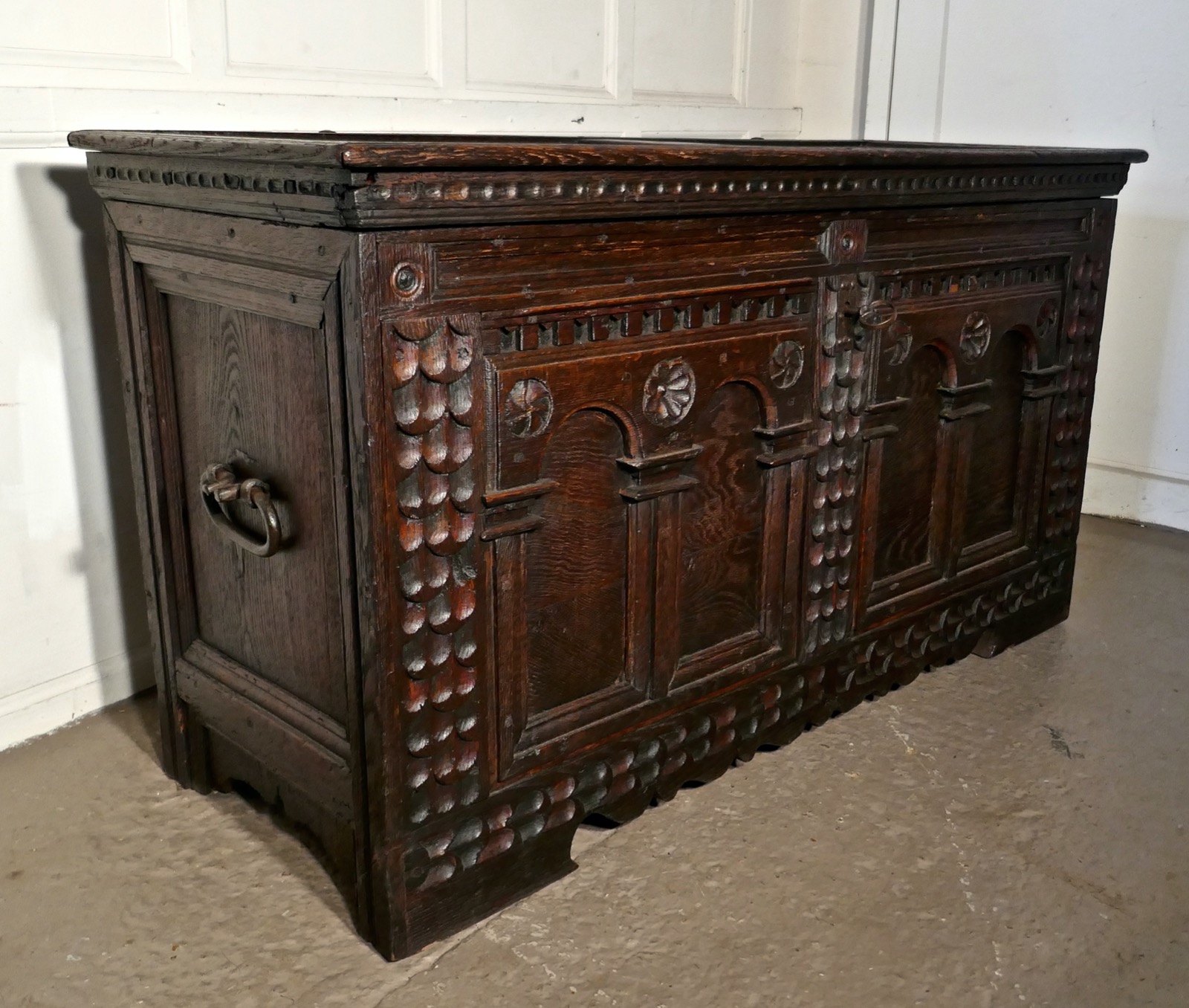
It was evening twilight when Henry went upstairs from the nursery by himself to look at the oak chest. He pressed his fingers into the carved fruit and flowers, and spoke to the dark-smiling heads at the corners; and then, with a glance over his shoulder, he opened the lid and looked in. But the chest concealed no treasure, neither gold nor baubles, nor was there anything to alarm the eye. The chest was empty, except that it was lined with silk of old-rose, seeming darker in the dusk, and smelling sweet of pot-pourri. And while Henry was looking in, he heard the softened laughter and the clinking of the cups downstairs in the nursery; and out at the window he saw the day darkening. These things brought strangely to his memory his mother who in her glimmering white dress used to read to him in the dusk; and he climbed into the chest; and the lid closed gently down over him.
When the other six children were tired with their playing, they filed into their grandmother's room for her good-night and her sugar-plums. She looked out between the candles at them as if she were uncertain of something in her thoughts. The next day Ann told her grandmother that Henry was not anywhere to be found.
'Dearie me, child. Then he must be gone away for a time,' said the old lady. She paused. 'But remember, all of you, do not meddle with the oak chest.'
But Matilda could not forget her brother Henry, finding no pleasure in playing without him. So she would loiter in the house thinking where he might be. And she carried her wooden doll in her bare arms, singing under her breath all she could make up about it. And when one bright morning she peeped in on the chest, so sweet-scented and secret it seemed that she took her doll with her into it--just as Henry himself had done.
So Ann, and James, and William, Harriet and Dorothea were left at home to play together. 'Some day maybe they will come back to you, my dears,' said their grandmother, 'or maybe you will go to them. Heed my warning as best you may.'
Now Harriet and William were friends together, pretending to be sweethearts; while James and Dorothea liked wild games of hunting, and fishing, and battles.
On a silent afternoon in October, Harriet and William were talking softly together, looking out over the slate roof at the green fields, and they heard the squeak and frisking of a mouse behind them in the room. They went together and searched for the small, dark hole from whence it had come out. But finding no hole, they began to finger the carving of the chest, and to give names to the dark-smiling heads, just as Henry had done. 'I know! let's pretend you are Sleeping Beauty, Harriet,' said William, 'and I'll be the Prince that squeezes through the thorns and comes in.' Harriet looked gently and strangely at her brother but she got into the box and lay down, pretending to be fast asleep, and on tiptoe William leaned over, and seeing how big was the chest, he stepped in to kiss the Sleeping Beauty and to wake her from her quiet sleep. Slowly the carved lid turned on its noiseless hinges. And only the clatter of James and Dorothea came in sometimes to recall Ann from her book.
But their old grandmother was very feeble, and her sight dim, and her hearing extremely difficult.
Snow was falling through the still air upon the roof; and Dorothea was a fish in the oak chest, and James stood over the hole in the ice, brandishing a walking-stick for a harpoon, pretending to be an Esquimau. Dorothea's face was red, and her wild eyes sparkled through her tousled hair. And James had a crooked scratch upon his cheek. 'You must struggle, Dorothea, and then I shall swim back and drag you out. Be quick now!' He shouted with laughter as he was drawn into the open chest. And the lid closed softly and gently down as before.
Ann, left to herself, was too old to care overmuch for sugar-plums, but she would go solitary to bid her grandmother good-night; and the old lady looked wistfully at her over her spectacles. 'Well, my dear,' she said with trembling head; and she squeezed Ann's fingers between her own knuckled finger and thumb. 'What lonely old people, we two are, to be sure!' Ann kissed her grandmother's soft, loose cheek. She left the old lady sitting in her easy chair, her hands upon her knees, and her head turned sidelong towards her.
When Ann was gone to bed she used to sit reading her book by candlelight. She drew up her knees under the sheets, resting her book upon them. Her story was about fairies and gnomes, and the gently-flowing moonlight of the narrative seemed to illumine the white pages, and she could hear in fancy fairy voices, so silent was the great many-roomed house, and so mellifluent were the words of the story. Presently she put out her candle, and, with a confused babel of voices close to her ear, and faint swift pictures before her eyes, she fell asleep.
And in the dead of night she rose out of her bed in dream, and with eyes wide open yet seeing nothing of reality, moved silently through the vacant house. Past the room where her grandmother was snoring in brief, heavy slumber, she stepped lightly and surely, and down the wide staircase. And Vega the far-shining stood over against the window above the slate roof. Ann walked into the strange room beneath as if she were being guided by the hand towards the oak chest. There, just as if she were dreaming it was her bed, she laid herself down in the old rose silk, in the fragrant place. But it was so dark in the room that the movement of the lid was indistinguishable.
Through the long day, the grandmother sat in her bow-window. Her lips were pursed, and she looked with dim, inquisitive scrutiny upon the street where people passed to and fro, and vehicles rolled by. At evening she climbed the stair and stood in the doorway of the large spare bedroom. The ascent had shortened her breath. Her magnifying spectacles rested upon her nose. Leaning her hand on the doorpost she peered in towards the glimmering square of window in the quiet gloom. But she could not see far, because her sight was dim and the light of day feeble. Nor could she detect the faint fragrance as of autumnal leaves. But in her mind was a tangled skein of memories--laughter and tears, and children long ago become old-fashioned, and the advent of friends, and last farewells. And gossiping fitfully, inarticulately, with herself, the old lady went down again to her window-seat.

Friday, 12 June 2020

The Clock


by W. F. Harvey

I liked your description of the people at the pension. I can just picture that rather sinister Miss Cornelius, with her toupee and clinking bangles. I don't wonder you felt frightened that night when you found her sleepwalking in the corridor. But after all, why shouldn't she sleepwalk? As to the movements of the furniture in the lounge on the Sunday, you are, I suppose, in an earthquake zone, though an earthquake seems too big an explanation for the ringing of that little handbell on the mantelpiece. It's rather as if our parlour maid — another new one! — were to call a stray elephant to account for the teapot we found broken yesterday. You have at least escaped the eternal problem of maids in Italy.
Yes, my dear, I most certainly believe you. I have never had experiences quite like yours, but your mention of Miss Cornelius has reminded me of something rather similar that happened nearly twenty years ago, soon after I left school. I was staying with my aunt in Hampstead. You remember her, I expect; or, if not her, the poodle, Monsieur, that she used to make perform such pathetic tricks. There was another guest, whom I had never met before, a Mrs Caleb. She lived in Lewes and had been staying with my aunt for about a fortnight, recuperating after a series of domestic upheavals, which had culminated in her two servants leaving her at an hour's notice – without any reason, according to Mrs Caleb, but I wondered. I had never seen the maids; I had seen Mrs Caleb and, frankly, I disliked her. She left the same sort of impression on me as I gather your Miss Cornelius leaves on you — something queer and secretive; underground, if you can use the expression, rather than underhand. And I could feel in my body that she did not like me.
It was summer. Joan Denton — you remember her; her husband was killed in Gallipoli — had suggested that I should go down to spend the day with her. Her people had rented a little cottage some three miles out of Lewes. We arranged a day. It was gloriously fine for a wonder, and I had planned to leave that stuffy old Hampstead house before the old ladies were astir. But Mrs Caleb waylaid me in the hall, just as I was going out.
“I wonder,” she said, “I wonder if you could do me a small favour. If you do have any time to spare in Lewes — only if you do — would you be so kind as to call at my house? I left a little travelling-clock there in the hurry of parting. If it's not in the drawing-room, it will be in my bedroom or in one of the maids' bedrooms. I know I lent it to the cook, who was a poor riser, but I can't remember if she returned it. Would it be too much to ask? The house has been locked up for twelve days, but everything is in order. I have the keys here. The large one is for the garden gate, the small one for the front door.”
I could only accept, and she proceeded to tell me how I could find Ash Grove House.
“You will feel quite like a burglar,” she said. “But mind, it's only if you have time to spare.”
As a matter of fact I found myself glad of any excuse to kill time. Poor old Joan had been taken suddenly ill in the night — they feared appendi­citis — and though her people were very kind and asked me to stay to lunch, I could see that I should only be in the way, and made Mrs Caleb's commission an excuse for an early departure.
I found Ash Grove without difficulty. It was a medium-sized red­brick house, standing by itself in a high walled garden that bounded a narrow lane. A flagged path led from the gate to the front door, in front of which grew, not an ash, but a monkey-puzzle, that must have made the rooms unnecessarily gloomy. The side door, as I expected, was locked. The dining-room and drawing-room lay on either side of the hall and, as the windows of both were shuttered, I left the hall door open, and in the dim light looked round hurriedly for the clock, which, from what Mrs Caleb had said, I hardly expected to find in either of the downstairs rooms. It was neither on table nor mantelpiece. The rest of the furniture was carefully covered over with white dust-sheets. Then I went upstairs. But, before doing so, I closed the front door. I did in fact feel rather like a burglar, and I thought that if anyone did happen to see the front door open, I might have difficulty in explaining things.
Happily the upstairs windows were not shuttered. I made a hurried search of the principal bedrooms. They had been left in apple-pie order; nothing was out of place; but there was no sign of Mrs Caleb's clock. The impression that the house gave me — you know the sense of personality that a house conveys — was neither pleasing nor displeasing, but it was stuffy, stuffy from the absence of fresh air, with an additional stuffiness added, that seemed to come out from the hangings and quilts and antimacassars. The corridor, onto which the bedrooms I had examined opened, communicated with a smaller wing, an older part of the house, I imagined, which contained a box-room and the maids' sleeping-quarters. The last door that I unlocked (I should say that the doors of all the rooms were locked, and relocked by me after I had glanced inside them) contained the object of my search. Mrs Caleb's travelling-clock was on the mantelpiece, ticking away merrily.
That was how I thought of it at first. And then for the first time I realised that there was something wrong. The clock had no business to be ticking. The house had been shut up for twelve days. No one had come in to air it or to light fires. I remember how Mrs Caleb had told my aunt that if she left the keys with a neighbour, she was never sure who might get hold of them. And yet the clock was going.
I wondered if some vibration had set the mechanism in motion, and pulled out my watch to see the time. It was five minutes to one. The clock on the mantelpiece said four minutes to the hour. Then, without quite knowing why, I shut the door on to the landing, locked myself in, and again looked round the room. Nothing was out of place. The only thing that might have called for remark was that there appeared to be a slight indentation on the pillow and the bed; but the mattress was a feather mattress, and you know how difficult it is to make them perfectly smooth. You won't need to be told that I gave a hurried glance under the bed — do you remember your supposed burglar in Number Six at St Ursula's? — and then, and much more reluctantly, opened the doors of two horribly capacious cupboards, both happily empty, except for a framed text with its face to the wall.
By this time I really was frightened. The clock went ticking on. I had a horrible feeling that an alarm might go off at any moment, and the thought of being in that empty house was almost too much for me. However, I made an attempt to pull myself together. It might after all be a fourteen-day clock. If it were, then it would be almost run down. I could roughly find out how long the clock had been going by winding it up. I hesitated to put the matter to the test, but the uncertainty was too much for me. I took it out of its case and began to wind. I had scarcely turned the winding-screw twice when it stopped. The clock clearly was not running down; the hands had been set in motion probably only an hour or two before.
I felt cold and faint and, going to the window, threw up the sash, letting in the sweet, live air of the garden. I knew now that the house was queer, horribly queer. Could someone be living in the house? Was someone else in the house now? I thought that I had been in all the rooms, but had I? I had only just opened the bathroom door, and I had certainly not opened any cupboards, except those in the room in which I was.
Then, as I stood by the open window, wondering what I should do next and feeling that I just couldn't go down that corridor into the darkened hall to fumble at the latch of the front door with I don't know what behind me, I heard a noise. It was very faint at first, and seemed to be coming from the stairs. It was a curious noise—not the noise of anyone climbing up the stairs, but — you will laugh if this letter reaches you by a morning post — of something hopping up the stairs, like a very big bird would hop. I heard it on the landing; it stopped. Then there was a curious scratching noise against one of the bedroom doors, the sort of noise you can make with the nail of your little finger scratching polished wood. Whatever it was, was coming slowly down the corridor, scratching at the doors as it went. I could stand it no longer. Nightmare pictures of locked doors opening filled my brain. I took up the clock, wrapped it in my Macintosh, and dropped it out of the window on to a flower-bed. Then I managed to crawl out of the window and, getting a grip of the sill, ‘successfully negotiated’, as the journalists would say, ‘a twelve-foot drop.’ So much for our much abused Gym at St Ursula's. Picking up the Macintosh, I ran round to the front door and locked it. Then I felt I could breathe, but not until I was on the far side of the gate in the garden wall did I feel safe.
Then I remembered that the bedroom window was open. What was I to do? Wild horses wouldn't have dragged me into that house again unaccompanied. I made up my mind to go to the police station and tell them everything. I should be laughed at, of course, and they might easily refuse to believe my story of Mrs Caleb's commission. I had actually  begun to walk down the lane in the direction of the town when I chanced to look back qt the house. The window that I had left open was shut.
No, my dear, I didn't see any face or anything dreadful like that... and, of course, it may have shut by itself. It was an ordinary sash-window, and you know they are often difficult to keep open.
And the rest? Why, there's really nothing more to tell. I didn't even see Mrs Caleb again. She had had some sort of fainting fit just before lunchtime, my aunt informed me on my return, and had had to go to bed. Next morning I travelled down to Cornwall to join mother and the children. I thought I had forgotten all about it, but when three years later Uncle Charles suggested giving me a travelling-clock for a twenty-first birthday present, I was foolish enough to prefer the alternative that he offered, a collected edition of the works of Thomas Carlyle.

Friday, 5 June 2020

The Mummy's Foot


by Théophile Gautier

translated by Lafcadio Hearn

I had entered, in an idle mood, the shop of one of those curiosity venders who are called marchands de bric-à-brac in that Parisian argot which is so perfectly unintelligible elsewhere in France.
You have doubtless glanced occasionally through the windows of some of these shops, which have become so numerous now that it is fashionable to buy antiquated furniture, and that every petty stockbroker thinks he must have his chambre au moyen âge.
There is one thing there which clings alike to the shop of the dealer in old iron, the ware-room of the tapestry maker, the laboratory of the chemist, and the studio of the painter: in all those gloomy dens where a furtive daylight filters in through the window-shutters the most manifestly ancient thing is dust. The cobwebs are more authentic than the gimp laces, and the old pear-tree furniture on exhibition is actually younger than the mahogany which arrived but yesterday from America.
The warehouse of my bric-à-brac dealer was a veritable Capharnaum. All ages and all nations seemed to have made their rendezvous there. An Etruscan lamp of red clay stood upon a Boule cabinet, with ebony panels, brightly striped by lines of inlaid brass; a duchess of the court of Louis xv. nonchalantly extended her fawn-like feet under a massive table of the time of Louis xiii., with heavy spiral supports of oak, and carven designs of chimeras and foliage intermingled.
Upon the denticulated shelves of several sideboards glittered immense Japanese dishes with red and blue designs relieved by gilded hatching, side by side with enamelled works by Bernard Palissy, representing serpents, frogs, and lizards in relief.
From disembowelled cabinets escaped cascades of silver-lustrous Chinese silks and waves of tinsel, which an oblique sunbeam shot through with luminous beads, while portraits of every era, in frames more or less tarnished, smiled through their yellow varnish.
The striped breastplate of a damascened suit of Milanese armour glittered in one corner; loves and nymphs of porcelain, Chinese grotesques, vases of céladon and crackleware, Saxon and old Sèvres cups encumbered the shelves and nooks of the apartment.
The dealer followed me closely through the tortuous way contrived between the piles of furniture, warding off with his hand the hazardous sweep of my coat-skirts, watching my elbows with the uneasy attention of an antiquarian and a usurer.
It was a singular face, that of the merchant; an immense skull, polished like a knee, and surrounded by a thin aureole of white hair, which brought out the clear salmon tint of his complexion all the more strikingly, lent him a false aspect of patriarchal bonhomie, counteracted, however, by the scintillation of two little yellow eyes which trembled in their orbits like two louis-d'or upon quicksilver. The curve of his nose presented an aquiline silhouette, which suggested the Oriental or Jewish type. His hands—thin, slender, full of nerves which projected like strings upon the finger-board of a violin, and armed with claws like those on the terminations of bats' wings—shook with senile trembling; but those convulsively agitated hands became firmer than steel pincers or lobsters' claws when they lifted any precious article—an onyx cup, a Venetian glass, or a dish of Bohemian crystal. This strange old man had an aspect so thoroughly rabbinical and cabalistic that he would have been burnt on the mere testimony of his face three centuries ago.
'Will you not buy something from me to-day, sir? Here is a Malay kreese with a blade undulating like flame. Look at those grooves contrived for the blood to run along, those teeth set backward so as to tear out the entrails in withdrawing the weapon. It is a fine character of ferocious arm, and will look well in your collection. This two-handed sword is very beautiful. It is the work of Josepe de la Hera; and this colichemarde with its fenestrated guard—what a superb specimen of handicraft!'
'No; I have quite enough weapons and instruments of carnage. I want a small figure,—something which will suit me as a paper-weight, for I cannot endure those trumpery bronzes which the stationers sell, and which may be found on everybody's desk.'
The old gnome foraged among his ancient wares, and finally arranged before me some antique bronzes, so-called at least; fragments of malachite, little Hindoo or Chinese idols, a kind of poussah-toys in jade-stone, representing the incarnations of Brahma or Vishnoo, and wonderfully appropriate to the very undivine office of holding papers and letters in place.
I was hesitating between a porcelain dragon, all constellated with warts, its mouth formidable with bristling tusks and ranges of teeth, and an abominable little Mexican fetich, representing the god Vitziliputzili au naturel, when I caught sight of a charming foot, which I at first took for a fragment of some antique Venus.
It had those beautiful ruddy and tawny tints that lend to Florentine bronze that warm living look so much preferable to the gray-green aspect of common bronzes, which might easily be mistaken for statues in a state of putrefaction. Satiny gleams played over its rounded forms, doubtless polished by the amorous kisses of twenty centuries, for it seemed a Corinthian bronze, a work of the best era of art, perhaps moulded by Lysippus himself.
'That foot will be my choice,' I said to the merchant, who regarded me with an ironical and saturnine air, and held out the object desired that I might examine it more fully.
I was surprised at its lightness. It was not a foot of metal, but in sooth a foot of flesh, an embalmed foot, a mummy's foot. On examining it still more closely the very grain of the skin, and the almost imperceptible lines impressed upon it by the texture of the bandages, became perceptible. The toes were slender and delicate, and terminated by perfectly formed nails, pure and transparent as agates. The great toe, slightly separated from the rest, afforded a happy contrast, in the antique style, to the position of the other toes, and lent it an aerial lightness—the grace of a bird's foot. The sole, scarcely streaked by a few almost imperceptible cross lines, afforded evidence that it had never touched the bare ground, and had only come in contact with the finest matting of Nile rushes and the softest carpets of panther skin.
'Ha, ha, you want the foot of the Princess Hermonthis!' exclaimed the merchant, with a strange giggle, fixing his owlish eyes upon me. 'Ha, ha, ha! For a paper-weight! An original idea!—artistic idea!-Old Pharaoh would certainly have been surprised had some one told him that the foot of his adored daughter would be used for a paper-weight after he had had a mountain of granite hollowed out as a receptacle for the triple coffin, painted and gilded, covered with hieroglyphics and beautiful paintings of the Judgment of Souls,' continued the queer little merchant, half audibly, as though talking to himself.
'How much will you charge me for this mummy fragment?'
'Ah, the highest price I can get, for it is a superb piece. If I had the match of it you could not have it for less than five hundred francs. The daughter of a Pharaoh! Nothing is more rare.'
'Assuredly that is not a common article, but still, how much do you want? In the first place let me warn you that all my wealth consists of just five louis. I can buy anything that costs five louis, but nothing dearer. You might search my vest pockets and most secret drawers without even finding one poor five-franc piece more.'
'Five louis for the foot of the Princess Hermonthis! That is very little, very little indeed. 'Tis an authentic foot,' muttered the merchant, shaking his head, and imparting a peculiar rotary motion to his eyes. 'Well, take it, and I will give you the bandages into the bargain,' he added, wrapping the foot in an ancient damask rag. 'Very fine? Real damask—Indian damask which has never been redyed. It is strong, and yet it is soft,' he mumbled, stroking the frayed tissue with his fingers, through the trade-acquired habit which moved him to praise even an object of such little value that he himself deemed it only worth the giving away.
He poured the gold coins into a sort of mediaeval alms-purse hanging at his belt, repeating:
'The foot of the Princess Hermonthis to be used for a paper-weight!'
Then turning his phosphorescent eyes upon me, he exclaimed in a voice strident as the crying of a cat which has swallowed a fish-bone:
'Old Pharaoh will not be well pleased. He loved his daughter, the dear man!'
'You speak as if you were a contemporary of his. You are old enough, goodness knows! but you do not date back to the Pyramids of Egypt,' I answered, laughingly, from the threshold.
I went home, delighted with my acquisition.
With the idea of putting it to profitable use as soon as possible, I placed the foot of the divine Princess Hermonthis upon a heap of papers scribbled over with verses, in themselves an undecipherable mosaic work of erasures; articles freshly begun; letters forgotten, and posted in the table drawer instead of the letter-box, an error to which absent-minded people are peculiarly liable. The effect was charming, bizarre, and romantic.
Well satisfied with this embellishment, I went out with the gravity and pride becoming one who feels that he has the ineffable advantage over all the passers-by whom he elbows, of possessing a piece of the Princess Hermonthis, daughter of Pharaoh.
I looked upon all who did not possess, like myself, a paper-weight so authentically Egyptian as very ridiculous people, and it seemed to me that the proper occupation of every sensible man should consist in the mere fact of having a mummy's foot upon his desk.
Happily I met some friends, whose presence distracted me in my infatuation with this new acquisition. I went to dinner with them, for I could not very well have dined with myself.
When I came back that evening, with my brain slightly confused by a few glasses of wine, a vague whiff of Oriental perfume delicately titillated my olfactory nerves. The heat of the room had warmed the natron, bitumen, and myrrh in which the paraschistes, who cut open the bodies of the dead, had bathed the corpse of the princess. It was a perfume at once sweet and penetrating, a perfume that four thousand years had not been able to dissipate.
The Dream of Egypt was Eternity. Her odours have the solidity of granite and endure as long.
I soon drank deeply from the black cup of sleep. For a few hours all remained opaque to me. Oblivion and nothingness inundated me with their sombre waves.
Yet light gradually dawned upon the darkness of my mind. Dreams commenced to touch me softly in their silent flight.
The eyes of my soul were opened, and I beheld my chamber as it actually was. I might have believed myself awake but for a vague consciousness which assured me that I slept, and that something fantastic was about to take place.
The odour of the myrrh had augmented in intensity, and I felt a slight headache, which I very naturally attributed to several glasses of champagne that we had drunk to the unknown gods and our future fortunes.
I peered through my room with a feeling of expectation which I saw nothing to justify. Every article of furniture was in its proper place. The lamp, softly shaded by its globe of ground crystal, burned upon its bracket; the water-colour sketches shone under their Bohemian glass; the curtains hung down languidly; everything wore an aspect of tranquil slumber.
After a few moments, however, all this calm interior appeared to become disturbed. The woodwork cracked stealthily, the ash-covered log suddenly emitted a jet of blue flame, and the discs of the pateras seemed like great metallic eyes, watching, like myself, for the things which were about to happen.
My eyes accidentally fell upon the desk where I had placed the foot of the Princess Hermonthis.
Instead of remaining quiet, as behoved a foot which had been embalmed for four thousand years, it commenced to act in a nervous manner, contracted itself, and leaped over the papers like a startled frog. One would have imagined that it had suddenly been brought into contact with a galvanic battery. I could distinctly hear the dry sound made by its little heel, hard as the hoof of a gazelle.
I became rather discontented with my acquisition, inasmuch as I wished my paper-weights to be of a sedentary disposition, and thought it very unnatural that feet should walk about without legs, and I commenced to experience a feeling closely akin to fear.
Suddenly I saw the folds of my bed-curtain stir, and heard a bumping sound, like that caused by some person hopping on one foot across the floor. I must confess I became alternately hot and cold, that I felt a strange wind chill my back, and that my suddenly rising hair caused my night-cap to execute a leap of several yards.
The bed-curtains opened and I beheld the strangest figure imaginable before me.
It was a young girl of a very deep coffee-brown complexion, like the bayadère Amani, and possessing the purest Egyptian type of perfect beauty. Her eyes were almond shaped and oblique, with eyebrows so black that they seemed blue; her nose was exquisitely chiselled, almost Greek in its delicacy of outline; and she might indeed have been taken for a Corinthian statue of bronze but for the prominence of her cheek-bones and the slightly African fulness of her lips, which compelled one to recognise her as belonging beyond all doubt to the hieroglyphic race which dwelt upon the banks of the Nile.
Her arms, slender and spindle-shaped like those of very young girls, were encircled by a peculiar kind of metal bands and bracelets of glass beads; her hair was all twisted into little cords, and she wore upon her bosom a little idol-figure of green paste, bearing a whip with seven lashes, which proved it to be an image of Isis; her brow was adorned with a shining plate of gold, and a few traces of paint relieved the coppery tint of her cheeks.
As for her costume, it was very odd indeed.
Fancy a pagne, or skirt, all formed of little strips of material bedizened with red and black hieroglyphics, stiffened with bitumen, and apparently belonging to a freshly unbandaged mummy.
In one of those sudden flights of thought so common in dreams I heard the hoarse falsetto of the bric-à-brac dealer, repeating like a monotonous refrain the phrase he had uttered in his shop with so enigmatical an intonation:
'Old Pharaoh will not be well pleased He loved his daughter, the dear man!'
One strange circumstance, which was not at all calculated to restore my equanimity, was that the apparition had but one foot; the other was broken off at the ankle!
She approached the table where the foot was starting and fidgeting about more than ever, and there supported herself upon the edge of the desk. I saw her eyes fill with pearly gleaming tears.
Although she had not as yet spoken, I fully comprehended the thoughts which agitated her. She looked at her foot—for it was indeed her own—with an exquisitely graceful expression of coquettish sadness, but the foot leaped and ran hither and thither, as though impelled on steel springs.
Twice or thrice she extended her hand to seize it, but could not succeed.
Then commenced between the Princess Hermonthis and her foot—which appeared to be endowed with a special life of its own—a very fantastic dialogue in a most ancient Coptic tongue, such as might have been spoken thirty centuries ago in the syrinxes of the land of Ser. Luckily I understood Coptic perfectly well that night.
The Princess Hermonthis cried, in a voice sweet and vibrant as the tones of a crystal bell:
'Well, my dear little foot, you always flee from me, yet I always took good care of you. I bathed you with perfumed water in a bowl of alabaster; I smoothed your heel with pumice-stone mixed with palm-oil; your nails were cut with golden scissors and polished with a hippopotamus tooth; I was careful to select tatbebs for you, painted and embroidered and turned up at the toes, which were the envy of all the young girls in Egypt. You wore on your great toe rings bearing the device of the sacred Scarabseus, and you supported one of the lightest bodies that a lazy foot could sustain.'
The foot replied in a pouting and chagrined tone:
'You know well that I do not belong to myself any longer. I have been bought and paid for. The old merchant knew what he was about. He bore you a grudge for having refused to espouse him. This is an ill turn which he has done you. The Arab who violated your royal coffin in the subterranean pits of the necropolis of Thebes was sent thither by him. He desired to prevent you from being present at the reunion of the shadowy nations in the cities below. Have you five pieces of gold for my ransom?'
'Alas, no! My jewels, my rings, my purses of gold and silver were all stolen from me,' answered the Princess Hermonthis with a sob.
'Princess,' I then exclaimed, 'I never retained anybody's foot unjustly. Even though you have not got the five louis which it cost me, I present it to you gladly. I should feel unutterably wretched to think that I were the cause of so amiable a person as the Princess Hermonthis being lame.'
I delivered this discourse in a royally gallant, troubadour tone which must have astonished the beautiful Egyptian girl.
She turned a look of deepest gratitude upon me, and her eyes shone with bluish gleams of light.
She took her foot, which surrendered itself willingly this time, like a woman about to put on her little shoe, and adjusted it to her leg with much skill.
This operation over, she took a few steps about the room, as though to assure herself that she was really no longer lame.
'Ah, how pleased my father will be! He who was so unhappy because of my mutilation, and who from the moment of my birth set a whole nation at work to hollow me out a tomb so deep that he might preserve me intact until that last day when souls must be weighed in the balance of Amenthi! Come with me to my father. He will receive you kindly, for you have given me back my foot.'
I thought this proposition natural enough. I arrayed myself in a dressing-gown of large-flowered pattern, which lent me a very Pharaonic aspect, hurriedly put on a pair of Turkish slippers, and informed the Princess Hermonthis that I was ready to follow her.
Before starting, Hermonthis took from her neck the little idol of green paste, and laid it on the scattered sheets of paper which covered the table.
'It is only fair,' she observed, smilingly, 'that I should replace your paper-weight.'
She gave me her hand, which felt soft and cold, like the skin of a serpent, and we departed.
We passed for some time with the velocity of an arrow through a fluid and grayish expanse, in which half-formed silhouettes flitted swiftly by us, to right and left.
For an instant we saw only sky and sea.
A few moments later obelisks commenced to tower in the distance; pylons and vast flights of steps guarded by sphinxes became clearly outlined against the horizon.
We had reached our destination.
The princess conducted me to a mountain of rose-coloured granite, in the face of which appeared an opening so narrow and low that it would have been difficult to distinguish it from the fissures in the rock, had not its location been marked by two stelae wrought with sculptures.
Hermonthis kindled a torch and led the way before me.
We traversed corridors hewn through the living rock. Their walls, covered with hieroglyphics and paintings of allegorical processions, might well have occupied thousands of arms for thousands of years in their formation. These corridors of interminable length opened into square chambers, in the midst of which pits had been contrived, through which we descended by cramp-irons or spiral stairways. These pits again conducted us into other chambers, opening into other corridors, likewise decorated with painted sparrow-hawks, serpents coiled in circles, the symbols of the tau and pedum—prodigious works of art which no living eye can ever examine—interminable legends of granite which only the dead have time to read through all eternity.
At last we found ourselves in a hall so vast, so enormous, so immeasurable, that the eye could not reach its limits. Files of monstrous columns stretched far out of sight on every side, between which twinkled livid stars of yellowish flame; points of light which revealed further depths incalculable in the darkness beyond.
The Princess Hermonthis still held my hand, and graciously saluted the mummies of her acquaintance.
My eyes became accustomed to the dim twilight, and objects became discernible.
I beheld the kings of the subterranean races seated upon thrones—grand old men, though dry, withered, wrinkled like parchment, and blackened with naphtha and bitumen—all wearing pshents of gold, and breastplates and gorgets glittering with precious stones, their eyes immovably fixed like the eyes of sphinxes, and their long beards whitened by the snow of centuries. Behind them stood their peoples, in the stiff and constrained posture enjoined by Egyptian art, all eternally preserving the attitude prescribed by the hieratic code. Behind these nations, the cats, ibixes, and crocodiles contemporary with them—rendered monstrous of aspect by their swathing bands—mewed, flapped their wings, or extended their jaws in a saurian giggle.
All the Pharaohs were there—Cheops, Chephrenes, Psammetichus, Sesostris, Amenotaph—all the dark rulers of the pyramids and syrinxes. On yet higher thrones sat Chronos and Xixouthros, who was contemporary with the deluge, and Tubal Cain, who reigned before it.
The beard of King Xixouthros had grown seven times around the granite table upon which he leaned, lost in deep reverie, and buried in dreams.
Further back, through a dusty cloud, I beheld dimly the seventy-two pre-adamite kings, with their seventy-two peoples, for ever passed away.
After permitting me to gaze upon this bewildering spectacle a few moments, the Princess Hermonthis presented me to her father Pharaoh, who favoured me with a most gracious nod.
'I have found my foot again! I have found my foot!' cried the princess, clapping her little hands together with every sign of frantic joy. 'It was this gentleman who restored it to me.'
The races of Kemi, the races of Nahasi—all the black, bronzed, and copper-coloured nations repeated in chorus:
'The Princess Hermonthis has found her foot again!'
Even Xixouthros himself was visibly affected.
He raised his heavy eyelids, stroked his moustache with his fingers, and turned upon me a glance weighty with centuries.
'By Oms, the dog of Hell, and Tmei, daughter of the Sun and of Truth, this is a brave and worthy lad!' exclaimed Pharaoh, pointing to me with his sceptre, which was terminated with a lotus-flower.
'What recompense do you desire?'
Filled with that daring inspired by dreams in which nothing seems impossible, I asked him for the hand of the Princess Hermonthis. The hand seemed to me a very proper antithetic recompense for the foot.
Pharaoh opened wide his great eyes of glass in astonishment at my witty request.
'What country do you come from, and what is your age?'
'I am a Frenchman, and I am twenty-seven years old venerable Pharaoh.'
'Twenty-seven years old, and he wishes to espouse the Princess Hermonthis who is thirty centuries old!' cried out at once all the Thrones and all the Circles of Nations.
Only Hermonthis herself did not seem to think my request unreasonable.
'If you were even only two thousand years old,' replied the ancient king, 'I would willingly give you the princess, but the disproportion is too great; and, besides, we must give our daughters husbands who will last well. You do not know how to preserve yourselves any longer. Even those who died only fifteen centuries ago are already no more than a handful of dust. Behold, my flesh is solid as basalt, my bones are bars of steel!
'I will be present on the last day of the world with the same body and the same features which I had during my lifetime. My daughter Hermonthis will last longer than a statue of bronze.
'Then the last particles of your dust will have been scattered abroad by the winds, and even Isis herself, who was able to find the atoms of Osiris, would scarce be able to recompose your being.
'See how vigorous I yet remain, and how mighty is my grasp,' he added, shaking my hand in the English fashion with a strength that buried my rings in the flesh of my fingers.
He squeezed me so hard that I awoke, and found my friend Alfred shaking me by the arm to make me get up.
'Oh, you everlasting sleeper! Must I have you carried out into the middle of the street, and fireworks exploded in your ears? It is afternoon. Don't you recollect your promise to take me with you to see M. Aguado's Spanish pictures?'
'God! I forgot all, all about it,' I answered, dressing myself hurriedly. 'We will go there at once. I have the permit lying there on my desk.'
I started to find it, but fancy my astonishment when I beheld, instead of the mummy's foot I had purchased the evening before, the little green paste idol left in its place by the Princess Hermonthis!